The number of self-service shops continues to rise in the Czech Republic
From grocery stores to hardware shops, almost everything is now available around the clock
Foto: COOP
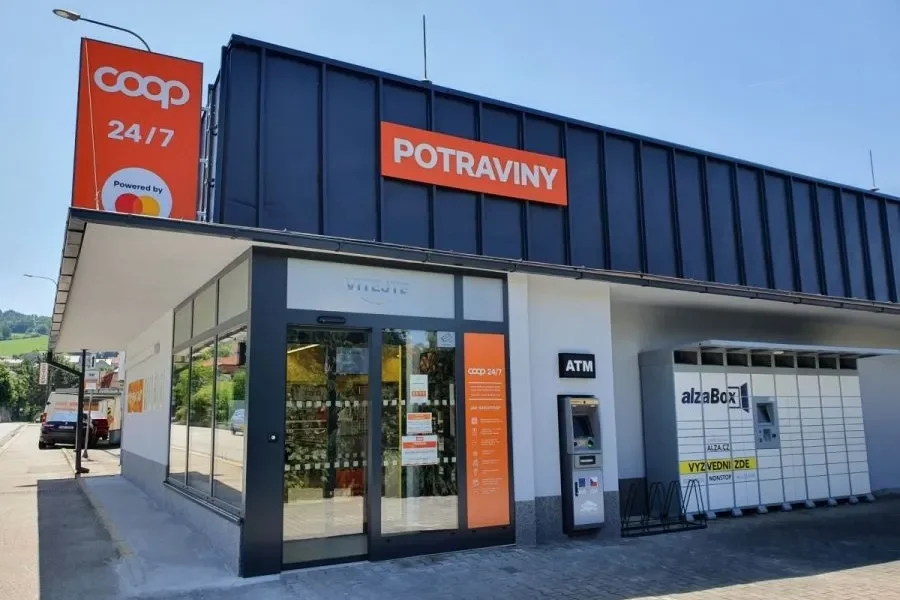
Self-service shops are becoming increasingly important in the Czech Republic. More and more retailers are turning to automated concepts that allow customers to shop 24 hours a day – particularly in areas where traditional staffed shops are no longer economically viable.
Over the past year, dozens of new self-service outlets, so-called “smart stores”, have opened in the Czech Republic, offering customers access 24 hours a day, seven days a week. Most of them are grocery stores, but the range is steadily expanding. Recently, a self-service coffee shop, a museum and a hardware store have also opened.
In most cases, these are so-called hybrid models. Staff are present during the day, while outside regular opening hours the operation runs entirely without personnel. The unmanned mode primarily serves as an extension of traditional opening times.
According to a report by the news channel ČT24, the greatest interest can be found in municipalities where a conventional staffed shop is not viable in the long term. For example, a corresponding store opened in early August 2025 in the municipality of Vidice in the Pilsen region. Previously, residents had to travel around ten kilometres to the nearest village to do their shopping.
In Prague, three such shops can be found, among other places, in student halls of residence of Charles University – in Kajetánka, Troja and the Hvězda hall.
At present, self-service shops in the Czech Republic are operated, among others, by the supermarket chain COOP and the franchise network Makro Můj obchod. The chains Tempo and Žabka have also announced new self-service branches on their websites. The trend towards more self-service shops therefore looks set to continue this year as well.
Identity verification required before shopping
Access to self-service shops usually requires prior identity verification. Users generally need to install an app and verify themselves, for example via bank identity, a digital ID card or another method. The generated QR code is used both to open the shop door and for payment.
Alternatively, digital chip cards are often used, which are issued by the operator once identity verification has been completed. Other access options include the use of a bank card, an identity card or verification via a telephone number.
More from Business