Building Permits in the Czech Republic at a 25-Year Low – Prague’s Housing Deficit Continues to Grow
The housing deficit in Prague has grown to almost 100,000 units over this period
Foto: Ümit Yıldırım | Unsplash
The number of building permits in the Czech Republic has fallen to its lowest level in more than 25 years. The situation in Prague in particular continues to worsen – with noticeable effects on prices and availability.
While the construction industry currently appears stable, the latest figures on building permits paint a far bleaker picture. According to the Czech Statistical Office (ČSÚ), only 61,613 building permits were issued nationwide last year – the lowest figure in more than 25 years.
In Prague, a total of 7,380 flats were approved, of which 5,907 were in multi-family buildings. Compared with the previous year, this represents a decline of 10 and 15 per cent respectively. For almost two decades, the Czech capital has failed to reach the mark of 10,000 newly approved and built flats per year – a level regarded as necessary for the development of the metropolis. As a result, the housing deficit in Prague has grown to almost 100,000 units over this period.
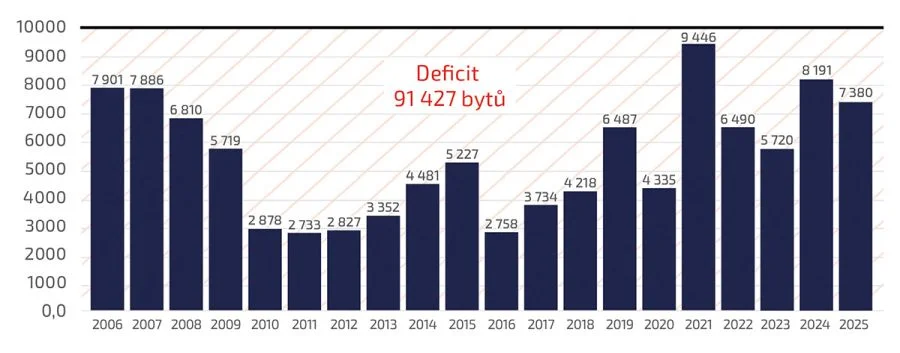
Grafic: Central Group
The persistent shortage of new flats is regarded as the main driver of further rising property prices. In the past year alone, the supply of new flats in Prague fell by a further 10 per cent. At the same time, strong demand is adding further pressure to prices. In addition, costs for construction services and land have risen sharply.
Over the past ten years, flat prices have increased by a total of 180 per cent. In the last year alone, the rise amounted to 9 per cent. The average price now stands at 178,000 crowns per square metre – a new record high.
Against this background, it is clear that the current Building Act is not achieving its objectives. Without fundamental systemic changes, neither a sustainable long-term development of the construction sector nor of the overall economy can be expected. Under these conditions, any noticeable improvement in housing availability is unlikely.
Relief could come from an amendment to the Building Act, which has already passed its first reading in the Chamber of Deputies. However, it will be crucial that the legislative process is not slowed down by political delays and that its original objective is not diluted by far-reaching amendments.
More from Real Estate
Prague City Museum Plans Redesign of Florenc Park – Visualisations Reveal First Concepts