



New High-Tech Labs at Podolí Waterworks Monitor Prague’s Drinking Water
More than 50,000 samples are examined in the laboratories each year, with almost 800,000 individual analyses of various parameters carried out
Photo: Pražské vodovody a kanalizace (PVK)
Prague’s water company has put a new, modern laboratory facility into operation in Podolí. There, the quality of Prague’s drinking water is monitored around the clock – increasingly also using PCR analyses, artificial intelligence and automated processes.
Prague is further expanding the monitoring of its drinking water supply. Pražské vodovody a kanalizace (PVK) has opened a new central laboratory facility on the premises of the Podolí waterworks. The laboratories have been relocated from their previous site in Prague’s Vinohrady district to Podolí and are intended to enable even faster and more precise monitoring of water quality.
Alongside traditional laboratory procedures, modern analytical methods will increasingly be used there in future. They are designed to detect possible changes or contamination significantly faster than conventional testing.
More than 50,000 water samples per year
The monitoring of Prague’s drinking water begins at the waterworks themselves. Among other methods, particularly sensitive rainbow trout are used there as biological indicators. The fish react even to small changes or contamination in the water.
In addition, chemical, microbiological and biological analyses are carried out regularly. At the points where water enters Prague, special spectrophotometric probes monitor important water parameters online. Numerous sensors are also installed throughout Prague’s water supply network, measuring, among other things, chlorine levels and water turbidity.
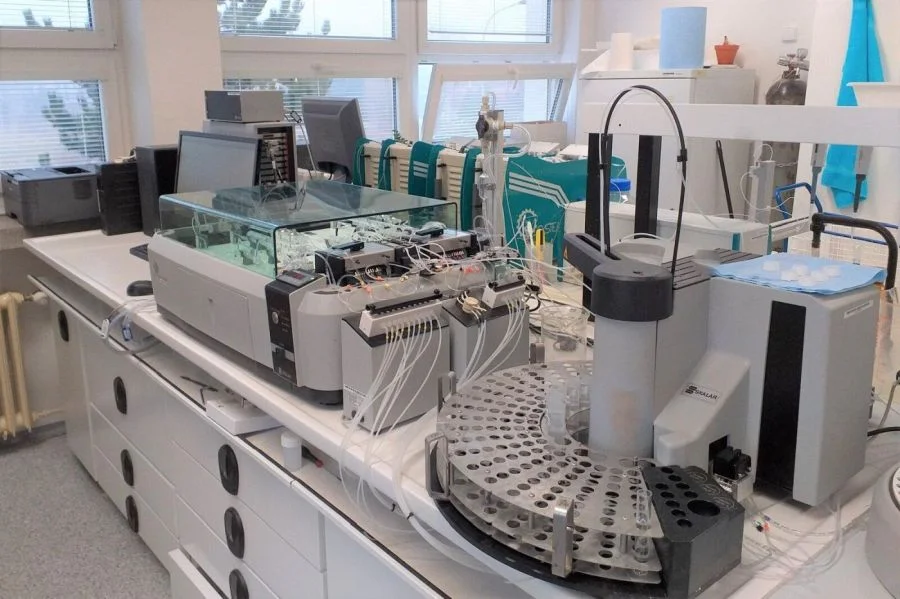
Photo: Pražské vodovody a kanalizace (PVK)
The laboratories themselves play a central role. According to PVK, more than 50,000 samples are examined there each year, with almost 800,000 individual analyses of various parameters carried out.
For Pavel Válek, Chairman of the Board of Pražská vodohospodářská společnost, investment in the new central laboratories is therefore one of the city’s important infrastructure projects. As the operator of the water management infrastructure, the company is aware of the importance of comprehensive quality control.
PCR technology to detect risks more quickly
One of the most important innovations is the routine use of the PCR method, or polymerase chain reaction. The procedure, which is well known from medicine, makes it possible to detect bacteria and viruses in water particularly quickly and precisely.
While traditional microbiological cultures can sometimes take several days, PCR can identify possible microbiological risks considerably earlier.
Artificial intelligence supports analysis
Artificial intelligence and machine learning are also set to play a greater role in monitoring water quality in future. The systems support laboratory staff in analysing large volumes of data and, according to PVK, can also detect very small deviations.
At the same time, the data collected is stored and is therefore also available for analysing possible disruptions or exceptional situations.
The new laboratories in Podolí are now fully operational. Samples from across Prague’s entire supply network are examined there every day – from the waterworks and the various treatment stages through to the distribution network of the Czech capital.