

High-Speed Rail Lines in the Czech Republic: Focus on International Corridors
Billion-euro investments and new priorities aim to drive the expansion of the high-speed network
Foto: Ministerstvo dopravy ČR
The Czech Republic is continuing to expand its high-speed rail network, focusing on key international connections. New priorities are intended to improve the chances of securing EU funding.
Preparations for the Czech high-speed rail network (VRT) are entering the next phase. The Ministry of Transport has presented the government with an updated report on the status of planning, outlining key corridors and future investment priorities.
This year, Správa železnic plans to invest around CZK 1.49 billion in the preparation of high-speed rail connections. Of this, CZK 0.96 billion will come from national sources, with a further CZK 0.53 billion from EU funds. In total, the state has already invested more than CZK 4 billion in preparatory work.
Transport Minister Ivan Bednárik described the development of a new high-speed rail network as one of the most ambitious infrastructure projects in the country’s history. In the coming years, the focus will be on expanding the central axis from Ústí nad Labem via Prague and Brno to Ostrava, complemented by international connections to Germany, Poland, Slovakia and Austria.
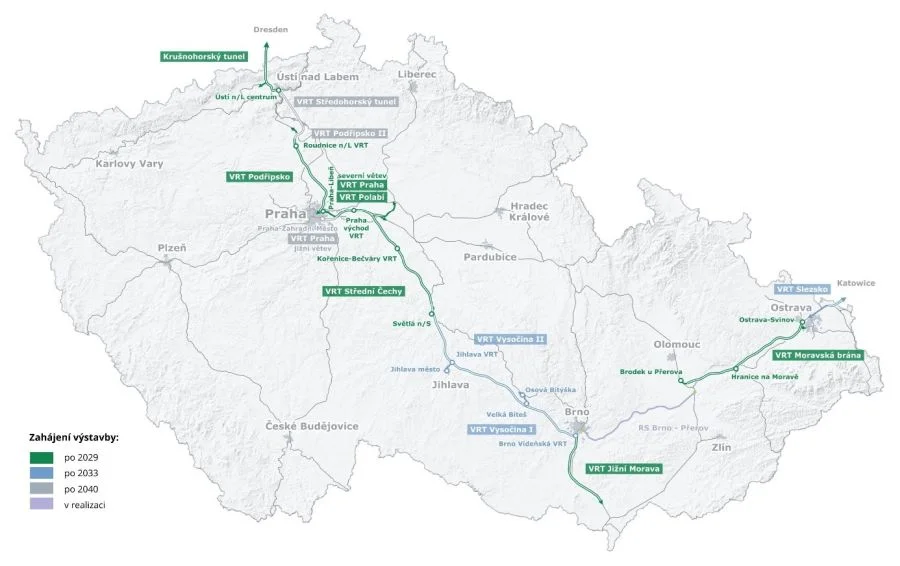
Foto: Ministerstvo dopravy ČR
Focus on international corridors
Particular priority is being given to the route towards Germany. Plans include a new line from Prague via the Podřipsko area to Ústí nad Labem, and further through a tunnel in the Ore Mountains into Germany. To the south, planning is focused on the Prague–Brno line and its continuation towards Austria and Slovakia – partly via new construction and partly through the modernisation of existing lines.
A third key axis is the so-called VRT “Moravská brána”, which is planned to run from Brodek u Přerova to Ostrava and onwards to Katowice in Poland.
EU funding will be decisive
A key factor for the future timeline remains funding from the European Union. Negotiations on the EU budget after 2028 are currently under way. In the future, Member States may compete more strongly for funding, increasing the pressure to prepare economically robust projects.
The long-term goal is to build a high-capacity, reliable and internationally connected rail network. This is intended not only to significantly reduce travel times, but also to free up capacity on existing lines for freight transport.
More from Business
ČD DNY: 25 Per Cent Discount on Group Train Travel in November
Moody’s Confirms Prague Airport’s Strong Financial Position with Aa3 Rating